
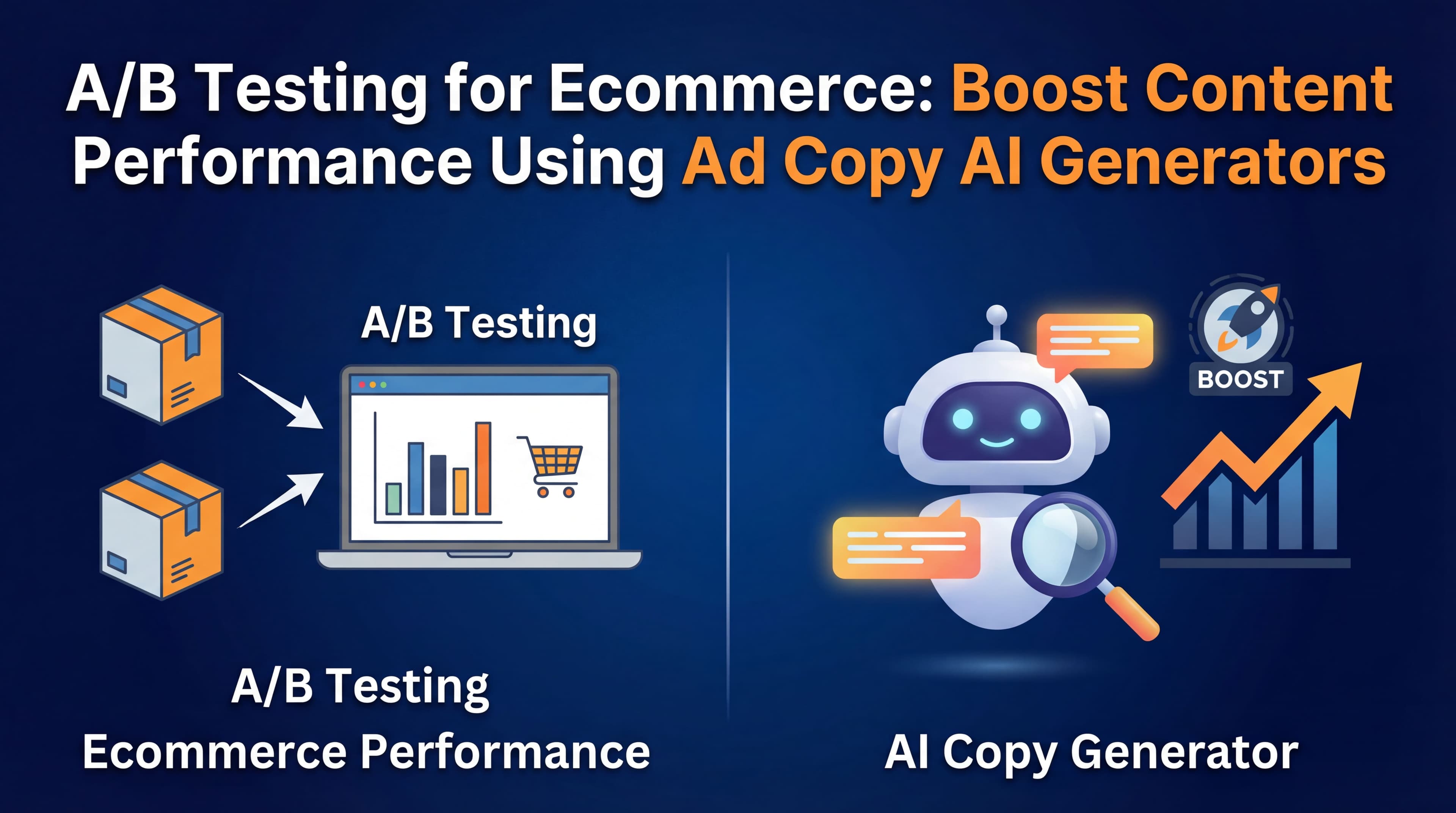
A/B Testing for Ecommerce: Boost Content Performance Using Ad Copy AI Generators
Imagive Content Team
January 21, 2026
A/B testing has become a core growth lever for ecommerce brands that rely on paid acquisition to scale. As competition on platforms like Google Ads intensifies, small improvements in messaging can unlock significant gains in click-through rates, conversions, and return on ad spend. At the centre of this evolution is how brands approach ad copy experimentation.
At Imagive.ai, we see many ecommerce teams struggle not with running tests, but with generating enough high-quality variations to test meaningfully. This is where copywriting for Google Ads intersects with AI-driven experimentation. With the right structure, AI can dramatically improve how quickly and intelligently ecommerce brands test what actually works.
In this article, we break down how A/B testing applies to ecommerce ad copy, where AI fits into the process, and how Imagive.ai helps teams turn testing into a performance system rather than a guessing game.
Why A/B Testing Matters in Ecommerce Advertising
Ecommerce buying decisions are often fast, intent-driven, and influenced by subtle cues. A single word change in an ad headline or description can shift perception from generic to compelling.
A/B testing allows marketers to compare variations of:
- Headlines and value propositions
- Call-to-action phrasing
- Price framing and offers
- Trust signals such as delivery speed or guarantees
Without structured testing, most ad copy decisions rely on assumptions. With structured testing, teams can identify which messages resonate with specific audiences at different stages of the funnel.
However, effective testing requires volume. One or two variations are rarely enough to uncover meaningful insights.
The Challenge of Scaling Ad Copy Experiments
Many ecommerce teams understand the value of testing but face practical limitations:
- Limited time to write multiple variations
- Repetition of similar messaging across campaigns
- Difficulty aligning copy with keyword intent
- Slow iteration cycles
This is especially common in performance teams managing dozens or hundreds of ad groups. Manual copywriting for Google Ads does not scale easily, and creative fatigue sets in quickly.
That is where AI-driven ad copy generation changes the equation.
How AI Supports A/B Testing for Google Ads
AI-powered tools can generate multiple ad copy variations in seconds, giving teams the raw material needed to run structured tests. A Google Ads ad copy generator can assist across several stages of the workflow.
Faster Variation Generation
Instead of writing one or two ads, teams can generate:
- Multiple headline options aligned to keyword intent
- Description variations focused on benefits, urgency, or proof
- Different tonal approaches such as direct, informative, or persuasive
This dramatically increases the number of testable combinations without increasing manual effort.
Intent and Structure Alignment
AI models trained on performance data understand common ad structures that align with search behaviour. In Google Ads ad copy generator workflows, this helps ensure variations are not random, but grounded in proven patterns.
Consistency Across Scale
For ecommerce brands running ads across multiple product categories, AI ensures consistency in messaging frameworks while allowing room for category-specific differentiation.
Where Human Judgment Still Matters
While AI accelerates execution, it does not replace strategic decision-making. Successful A/B testing depends on clarity around what is being tested and why.
Human marketers still define:
- The hypothesis behind each test
- The primary performance metric
- The audience and campaign context
- The interpretation of results
AI supports the creative supply side of testing. Humans remain responsible for strategy, prioritisation, and learning.
Turning A/B Testing into a System, Not a One-Off
One common mistake in ecommerce advertising is treating A/B tests as isolated experiments. Sustainable performance improvement comes from building a repeatable testing system.
A strong system includes:
- Clear test objectives
- Controlled variable changes
- Consistent evaluation windows
- Documented learnings
AI helps by ensuring teams always have enough variations to test, reducing friction in the experimentation process.
How We at Imagive.ai Enable Smarter Ad Copy Testing
At Imagive.ai, we designed our platform to support performance-focused experimentation rather than surface-level automation. We help ecommerce teams use AI to generate ad copy variations that are structured, intent-aware, and aligned with testing goals.
Our approach to copywriting for Google Ads focuses on:
- Creating meaningful variation rather than random rewrites
- Aligning ad copy with keyword themes and funnel stages
- Supporting rapid iteration without losing message clarity
Instead of treating a Google Ads ad copy generator as a black box, we integrate it into a broader workflow where AI assists with ideation and drafting, while marketers retain control over testing strategy and evaluation.
This allows teams to move faster without compromising on relevance, brand voice, or performance discipline.
Conclusion
A/B testing remains one of the most effective ways for ecommerce brands to improve paid media performance. The challenge is no longer whether to test, but how to test efficiently at scale.
By combining structured experimentation with AI-assisted ad copy generation, teams can unlock faster learning cycles and more consistent performance gains. At Imagive.ai, we built our platform to help ecommerce marketers turn AI into a practical testing partner, not a replacement for strategic thinking.
If your team is looking to scale ad copy testing without burning out creative resources, Imagive.ai helps you build a smarter, faster experimentation engine around what actually drives results.
FAQs
Q1. What is A/B testing in ecommerce advertising?
A/B testing compares different versions of ad copy to determine which performs better against defined metrics like clicks or conversions.
Q2. How does AI help with ad copy testing?
AI generates multiple copy variations quickly, allowing teams to test more ideas without increasing manual workload.
Q3. Is a Google Ads ad copy generator reliable for performance campaigns?
It is effective when used as a support tool alongside human strategy and review, not as a fully automated replacement.
Q4. What should ecommerce teams test first in Google Ads copy?
Headlines, value propositions, calls to action, and offer framing are strong starting points.
Q5. Can AI-generated copy replace manual copywriting?
No. AI accelerates drafting and ideation, but human oversight is essential for relevance and quality.
Q6. How often should ad copy tests be run?
Testing should be continuous, with clear evaluation windows and documented learnings to inform future campaigns.
Related Articles
See all →
AI
Step-by-Step Guide: Using Blog Writing Tools to Create SEO-Friendly Posts
4 min read
ImagiveAi
How Imagive AI Supercharges SEO Blog Writing for Marketers
5 min read
ImagiveAi
Writing Winning Facebook and Instagram Ads with Imagive AI
7 min read

ImagiveAi
How Imagive.ai Helps You Write and Test Winning Ads in Minutes, Not Days
4 min read
ImagiveAi
The ROI of AI-Generated Ad Creatives: How Performance Marketers Can Scale Faster
4 min read